Download and run local AI models via Ollama
Ollama app removed in Olares 1.12.6
The standalone Ollama app is no longer available in Olares Market starting with Olares 1.12.6.
- If you already installed Ollama on Olares 1.12.5 or earlier, the app keeps working after you update to 1.12.6. You can still pull and run models through the Ollama CLI and use the Ollama API endpoint. However, you cannot update the Ollama app itself from Olares Market.
- For new deployments on Olares 1.12.6 and later, use Ollama Engine Base instead. It provides the same Ollama inference engine through Olares Model Console.
Ollama is a lightweight platform that allows you to run open-source AI models like gemma3 and deepseek-r1 directly on your machine. Within Olares, you can integrate Ollama with graphical interfaces like Open WebUI or other agents to add more features and simplify interactions.
Learning objectives
In this guide, you will learn how to:
- Use the Ollama CLI on Olares to manage local LLMs.
- Configure Ollama as an API service for internal and external apps.
Prerequisites
- Olares admin privileges.
- The Ollama app already installed, if you are on Olares 1.12.6. New users should deploy Ollama Engine Base instead.
Install Ollama
Not available for new installations on Olares 1.12.6+
Starting with Olares 1.12.6, the standalone Ollama app is removed from Market. If you already have it installed, skip to the next section. If you are setting up a new model backend, see Host local large language models with Engine Base apps.
On Olares 1.12.5 and earlier:
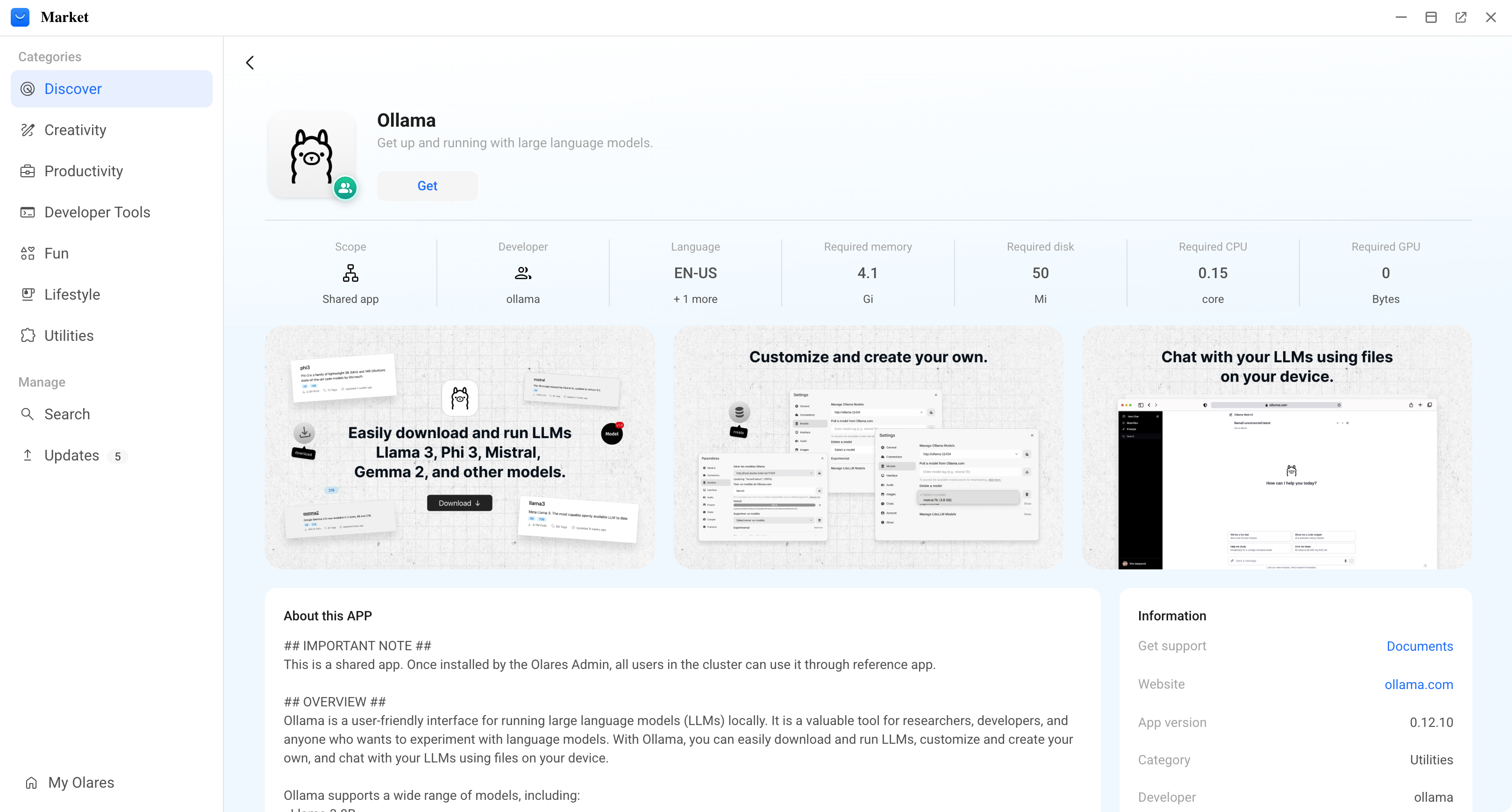
- Open Market, and search for "Ollama".
- Click Get, then Install, and wait for installation to complete.
Use Ollama Engine Base for new deployments
If you are starting fresh on Olares 1.12.6 or later, install Ollama Engine Base from Market. Engine Base apps are managed through Model Console and give you the same Ollama engine without relying on the removed standalone Ollama app.
Manage models with the Ollama CLI
Ollama CLI allows you to manage and interact with AI models directly from the Olares terminal. Below are the key commands.
Download a model
Check Ollama library
If you are unsure which model to download, check the Ollama Library to explore available models.
To download a model, use the following command:
ollama pull [model]Run a model
TIP
If the specified model has not been downloaded yet, the ollama run command will automatically download it before running.
To run a model, use the following command:
ollama run [model]After running the command, you can enter queries directly into the CLI, and the model will generate responses.
When you're finished interacting with the model, type:
/byeThis will exit the session and return you to the standard terminal interface.
Stop model
To stop a model that is currently running, use the following command:
ollama stop [model]List models
To view all models you have downloaded, use:
ollama listRemove a model
If you need to delete a model, you can use the following command:
ollama rm [model]Show information for a model
To display detailed information about a model, use:
ollama show [model]List running models
To see all currently running models, use:
ollama psConfigure Ollama API Access
To use Ollama as the backend for other applications on the same local network, make sure the API uses the correct access setting and copy the endpoint from the Ollama API page.
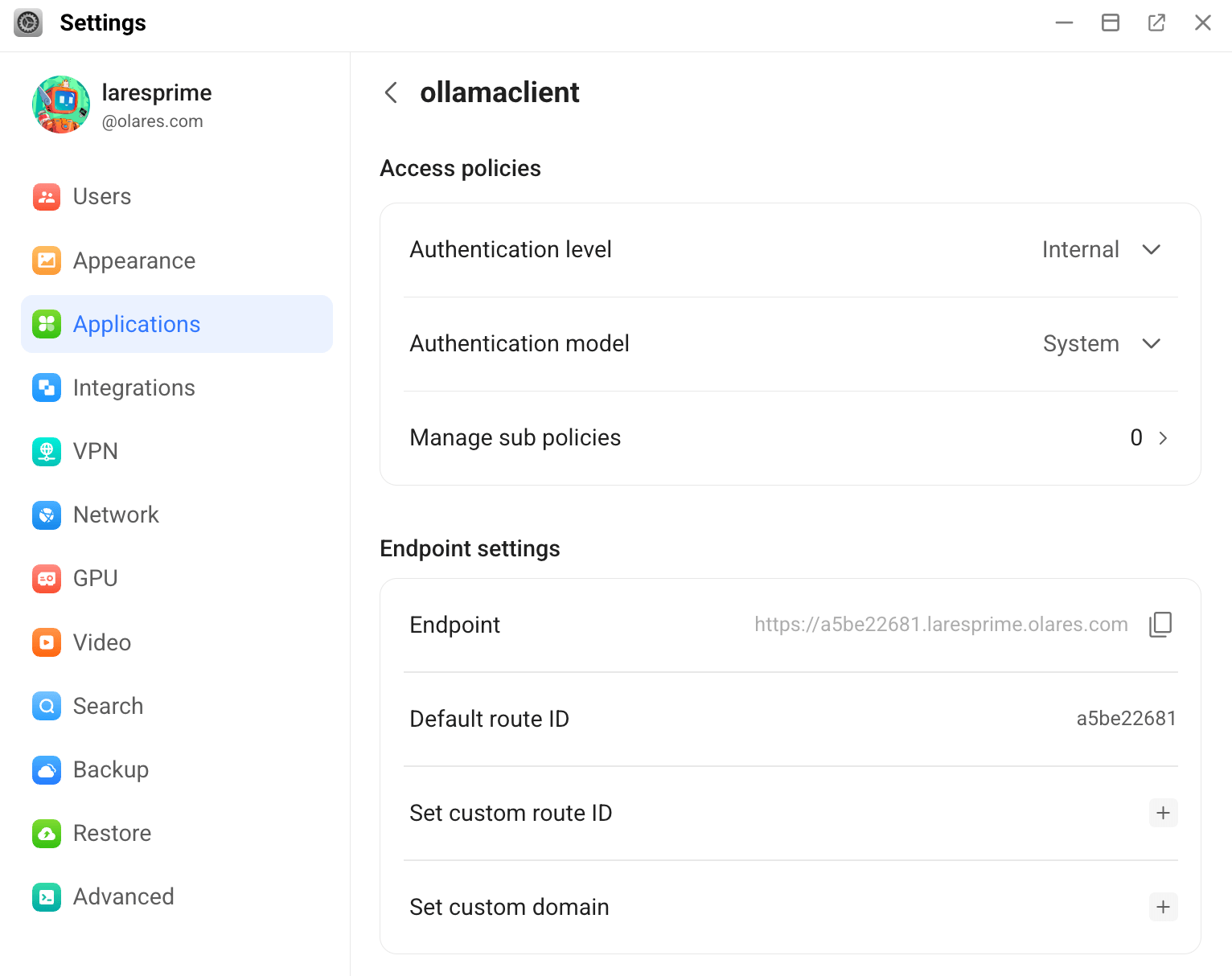
On Olares, open Settings, then go to Application > Ollama.
Under Entrances, click Ollama API.
Make sure that Authentication level is set to Internal. If you change the setting, click Submit.
Under Endpoint settings, copy the URL displayed in Endpoint. Use this address as the Base URL or Host in your application's settings.
For OpenAI-compatible endpoint
Some apps expect an OpenAI-compatible API. If the standard endpoint fails, try appending /v1 to your address. For example:
https://a5be22681.{YOURUSERNAME}.olares.com/v1If the application forces you to enter an API Key, you can usually enter any string (for example, ollama).
Ensure network connectivity
Because you set the authentication to "Internal", your application must be on the same local network as Olares to connect.
- Local network: If your device (or the app running on Olares) is on the same Wi-Fi or LAN, you can connect directly using the frontend address.
- Remote access: If you are accessing Olares remotely, you must enable LarePass VPN on your client device. This creates a secure tunnel that effectively places your device on the same network as Olares.