
Beyond the Cloud: The BEC Architecture for True Data Ownership

Your data is everywhere: on your phone, in the cloud, and behind every app you use. But who really controls it? This article explores the hidden risks of today’s digital world and introduces the Blockchain–Edge–Client (BEC) framework—a powerful architecture designed to put you back in charge of your information and identity.
The problem with today’s Internet
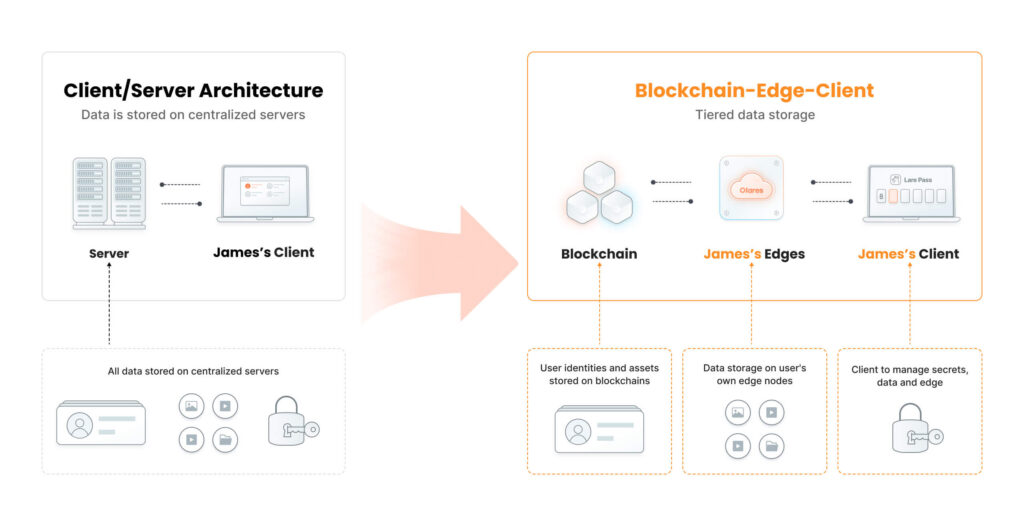
Most digital services run on a client/server model. Your device (the client) makes requests, and centralized servers process and store the results. Convenient, yes—but it concentrates power and creates serious risks:
- Data ownership is lost. Every message, photo, or search query lives on servers you don’t own. Accounts can vanish without appeal.
- Free speech is fragile. Platforms can delete content or block users at will.
- Privacy is under threat. Your information is tracked, profiled, and sold to the highest bidder.
- Data is fragmented. Your digital life is scattered across apps, trapped in isolated silos.
With AI increasingly trained on personal data, these risks intensify. We want the benefits of AI—but not at the cost of our digital autonomy.
Where should your data live?
If centralized servers are the problem, where should data live instead? Different approaches have been tried, each with strengths but also limitations.
Blockchain
Blockchains allow verifiable ownership of digital assets and identities through cryptographic keys. This gives users trust and immutability—once something is on-chain, no one can unilaterally alter it.
But blockchains alone cannot serve as a universal home for data:
- Low throughput hinders global-scale, data-heavy applications.
- High storage costs make on-chain documents and media impractical.
- Dynamic data challenges frequent edits, chats and multimedia.
In short, blockchain is excellent for anchoring trust and identity, but unsuitable as a home for all your digital life.
Local devices
Local-first software keeps data on your own devices. Tools like Obsidian and Logseq give users control and sync across devices via services like iCloud or Seafile.
This approach puts you in direct control, but it comes with challenges:
- Devices aren’t always online due to battery and connectivity.
- Synchronization conflicts may occur when two devices change the same file.
- Mobile hardware is less cost-effective than centralized infrastructure.
Local-first works well for personal notes and small-scale collaborations, but it struggles with always-on, global services.
The BEC approach
The Blockchain–Edge–Client (BEC) framework offers a balanced path, placing each type of data where it naturally belongs.
Blockchain — Anchoring trust
Critical information, like identities, credentials and transactions, is stored on-chain. Blockchain guarantees immutability, transparency, and discoverability. Unlike traditional centralized platforms, users can validate records independently and ensure they have not been tampered with.
Think of it as a bank ledger: each transaction is logged and verifiable, but daily conversations and document edits remain private.
Edge — Your personal cloud
Everyday data—documents, chat logs, photos—resides on your private Edge server, acting as a personal cloud. All your interactions, whether with people or services, pass through it. Unlike centralized platforms, the Edge belongs to you, ensuring control and privacy.
Beyond storage, the Edge can host AI agents that understand context and act on your behalf, turning it into a second brain and digital persona. This enables smarter workflows while keeping your sensitive data private.
Client — Keys in your hands
Finally, the client layer ensures that control never leaves your device. In BEC, you—not the service provider—hold the private keys that govern decentralized identifiers (DID) and access permissions on Edge. These keys live in wallet apps on mobile or browser platforms, giving you final authority over identity, data, and assets.
This approach reflects a core security principle: people feel more secure when custody stays local, just as blockchain wallets demonstrate. It balances security with usability across devices.
How BEC works in practice
Consider Alice sending a message to James:
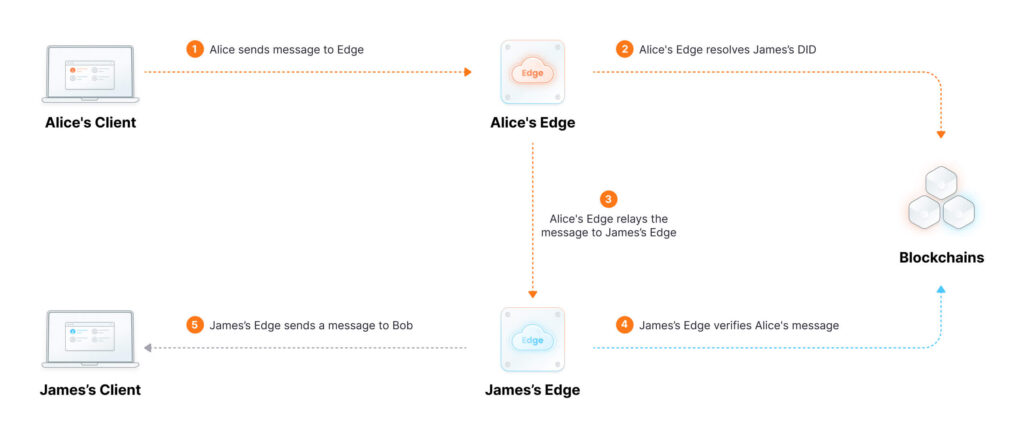
- Step 1: From device to Edge. Alice types a message on her device, which first goes to her private Edge server.
- Step 2: Finding James’s Edge. Her Edge queries the blockchain—a decentralized directory—to locate James’s Edge.
- Step 3: Edge-to-Edge delivery. The message flows peer-to-peer from Alice’s Edge to James’s Edge, with no central server intercepting it.
- Step 4: Verifying authenticity. James’s Edge verifies Alice’s digital signature against the blockchain.
- Step 5: Reaching James. Once verified, the message is delivered securely to James’s device.
In this flow, no platform is able to intercept, censor, or monetize the interaction. The blockchain provides trust, the Edge servers handle data exchange, and the client keeps control of the keys. Together, they demonstrate how BEC enables secure, direct communication—free from the compromises of the traditional client/server model.
Olares: A real-world implementation of BEC
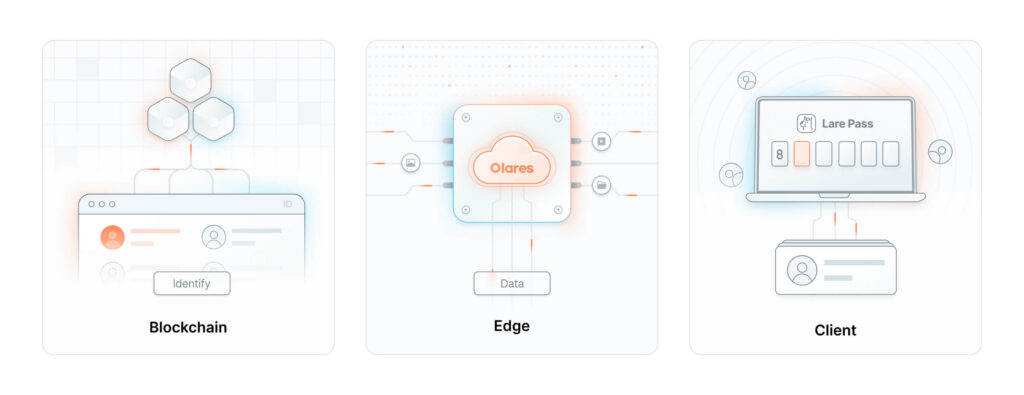
The BEC framework provides the architectural blueprint, while Olares brings it to life—an open-source, self-hosted personal cloud system that implements each BEC layer: blockchain, Edge, and client—keeping you in full control of your data and identity.
Blockchain: Public trust with Olares ID
Olares uses Olares ID, a decentralized identity system, to anchor trust. Each user starts with a mnemonic phrase that generates private keys and a DID. The DID links to a human-readable Olares ID (e.g., alice813@olares.com) and is recorded on-chain, letting others verify your identity and locate your Edge. Think of it as a combination of DNS and certificate pinning—portable, verifiable, and independent of centralized platforms.
Edge: Personal cloud with Olares OS
Olares OS is designed to turn any device—home server, VPS, or dedicated machine—into a secure personal cloud. All user data, applications, and AI workloads remain on the Edge, without ever touching the blockchain. By automating complex configurations and security, Olares OS makes self-hosting simple and accessible, even for non-experts. It offers several key features:
- Applications run in isolated namespaces for compute, network, storage, and identity. Sandboxing ensures separation and prevents interference.
- Zero-trust security uses short-lived tokens to sign and audit cross-application requests, reducing the risk of unauthorized access.
- Flexible connectivity enables peer-to-peer communication. Nodes behind NAT use automatic relays or tunnels such as Tailscale or FRP. Public services can be fronted by Cloudflare with TLS, while private services remain fully under user control.
Olares OS makes the Edge the engine of your digital autonomy, managing data, applications, and workloads while keeping control fully in your hands.
Client: Local custody with LarePass
LarePass keeps private keys and Olares ID strictly on your device. It handles cryptography, credentials, and secure sessions transparently, so you retain full authority over your identity and assets while interacting with your Edge.
From vision to reality
The BEC framework reimagines the Internet from a user-first perspective. It addresses the shortcomings of traditional client/server models, the limits of blockchain, and the challenges of local-first software. By distributing data intelligently—blockchain for critical records, Edge for everyday data, and client apps for key custody—BEC restores control to you.
Olares makes this vision a practical reality. With it, your data remains private, your identity stays yours, and your assets are secure. With BEC and Olares, the Internet feels familiar—but the power is back where it belongs: in your hands.