
One-Time PDF Q&A or a Persistent Client Document Collection?


Use a one-time upload when you have a bounded, temporary question about a client PDF. Choose a persistent document collection only when you expect to come back to the same client materials again and again, and that reuse is worth the ongoing indexing and access review a collection needs.
Convenience alone should not make the call. With either approach, keep each client project clearly bounded and check every answer against the source passage before you rely on it.
Choose by Expected Reuse and Upkeep
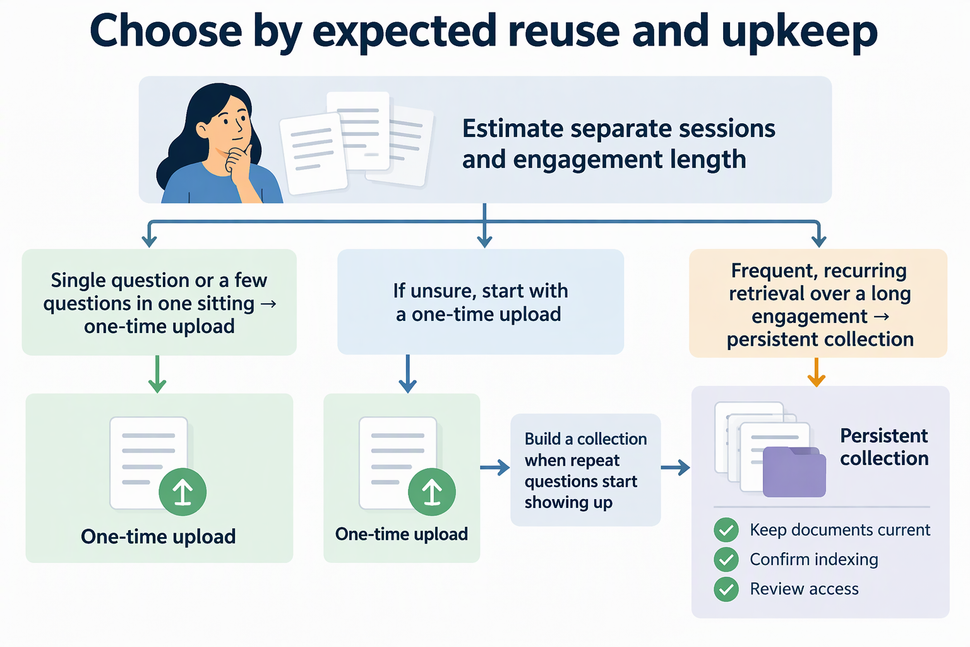
The deciding question is how often you will return to the same documents, and for how long. A one-time upload fits a question with a clear end. Say you need the termination terms in a single contract, or a summary of one audit report before tomorrow’s call. You attach the file, ask, check the answer, and you are done. You avoid maintaining a reusable collection, but the tool may still retain the upload, chat, extracted text, or logs. Check its retention and deletion controls when the task ends.
A persistent collection is built for a different job. It holds a curated set of documents that you can reuse across many separate chats. That fits an ongoing engagement, where the same policy manuals, board decks, or project reports keep coming up in new questions over weeks or months. You stop re-uploading the same files every session, and every question draws on one defined set of materials.
That reuse has a cost, though. A collection only stays useful if you keep it current. You add new versions, remove superseded drafts, and confirm the documents are still indexed so retrieval reflects what is actually there. It also stays available, so you have to keep reviewing who can reach it. If you build a collection for material you never return to, you take on that upkeep without getting anything for it.
No single number of questions or weeks makes a collection worthwhile. Estimate two things instead. First, how many separate sessions will need these same PDFs? Second, how long will the engagement last? Frequent, recurring retrieval over a long engagement points toward a collection. A single question, or a few questions in one sitting, points toward a one-time upload. If you can’t tell yet, start with a one-time upload. Build a collection once the repeat questions actually start showing up.
As one example, the Olares guide to documents and knowledge bases in Open WebUI documents both paths in one app running on Olares. You upload a PDF or text file to a new chat for one-off analysis. For documents you want to reuse across chats, you create a knowledge base under Workspace > Knowledge and attach it to a chat. The guide lists a connected local model, Open WebUI administrator privileges, and an embedding model as prerequisites.
Keep Client Projects Clearly Bounded
Treat each client engagement as its own document boundary, and define it before anything goes into a reusable collection. Know which engagement each retained PDF belongs to. Don’t mix materials from different clients, or from unrelated projects for the same client, in one collection just because they cover similar topics. A mixed collection can pull a passage from the wrong engagement into an answer, and that is hard to notice once it happens.
Next, decide who is supposed to have access. Ask whether the collection is just for you, or for a colleague on the same engagement. Write that down when you create the collection, and review it again when team members change. These are handling practices you own. Don’t assume a document-Q&A tool separates projects or restricts access unless you have confirmed that for your own setup.
The one-time route needs the same care. Uploading a file to a single chat is not a privacy guarantee in itself. Where that file and chat end up depends on the tool and how it is configured. So the scope question applies to both routes: does this client’s material belong in this tool at all, and under whose access? Check the chat model, embedding model, and any OCR or document-extraction service separately. A locally hosted interface can still send document content to a remote provider selected in its settings.
Verify Answers Against the Source PDFs
Before you use an answer in client work, follow its citation back to the original PDF and read the cited passage in context. Find the exact page or section the answer points to. Then read the paragraphs around it. Qualifications, exceptions, defined terms, and footnotes often sit right next to the sentence that was retrieved, and they can reverse its meaning.
Then ask a simple question: does the passage actually say what the answer claims, with the same conditions and scope? If the answer leaves out a condition, mixes up two sections, or reaches past what the text says, correct it from the source. Don’t pass the model’s wording along as-is.
A citation shows which material entered the response. It does not prove the answer is right. In the Open WebUI guide, for example, file citations in a reply signal that the document was added to the context. That tells you where to look, not that the reasoning holds up. This check applies the same way to one-time uploads and to persistent collections.
FAQs
What should I do with a collection when the engagement ends?
Go back to the boundary you set at the start. If you don’t expect follow-up work, remove the collection or archive its source files according to your client agreement and retention practice. If follow-up is likely, keep it, but review access first, since team members may have changed.
Can I start with a one-time upload and switch to a collection later?
Yes. Moving from one-off questions to a collection is a reasonable path once repeat questions show up. When you build it, upload the current versions of the documents instead of whatever you used in earlier chats, so the collection starts clean.
What if the engagement scope changes midway?
Treat the change as a new boundary decision. If new work streams bring in documents with different audiences or sensitivity, consider a separate collection rather than expanding the existing one. Then check that the intended access still fits everything in it.
Do scanned or complex-layout PDFs change the choice?
They don’t change the reuse decision, but they make the source check more important. Text extraction from scans, tables, or multi-column layouts may be incomplete, so compare cited passages against the original page image. Some tools offer advanced extraction engines, which can add processing cost, so they may not suit every file.