
Evaluate a Local Model With Representative Document Questions


To find out whether a local model can handle your documents, test it on a small set of real or realistic questions from that exact task. Judge each answer against the relevant document passages. Score three things separately: what the answer supports, what it leaves out, and which claims have no backing in the evidence.
Public benchmark scores are still useful background, but they come from someone else’s tasks. Your result applies only to the documents, questions, model, and setup you actually tested. If you include retrieval, record the retrieved passages too, so you can tell whether a failure came from search or from the model.
Why Public Benchmarks Don’t Settle Your Document Task
A public benchmark measures how a model performs on that benchmark’s specific questions and inputs rather than your actual workload. Your documents bring distinct vocabulary, layouts, and question patterns that general test suites do not replicate. For instance, contract clauses, internal runbooks, and scanned research PDFs each put different demands on a model.
One evaluation guide notes that public benchmarks give quick initial insights, but public benchmarks often lack use-case specificity. That is the line to hold. A strong leaderboard result can help you pick which models to try first. It cannot tell you how a model will answer questions about your files or behave inside your workflow.
So use benchmarks as a first filter, not a stand-in for your own result. If you want to say “this model works for our document Q&A,” you need a test built from that document Q&A task.
Build a Compact Test Around the Intended Task
Start by defining the document job in one or two sentences, specifying what files the model reads, who asks the questions, and what output format is required. A concise answer, a list of procedural steps, or an extracted field like a date each represent distinct response formats with different failure modes.
Next, pick questions that match that job. The guide recommends evaluation data that fits task scope, expected usage, and input variety. In practice, that means three things:
- Use real or realistic queries. Pull them from support tickets, search logs, or questions colleagues actually ask, not from clean textbook prompts.
- Cover the meaningful patterns. If users ask both “what does section 4 say about refunds?” and “compare the 2023 and 2024 policies,” include both kinds. Include the document types you really use too, such as long PDFs, tables, and short memos.
- Avoid a convenient but narrow set. Ten easy lookups from a single document will flatter almost any model.
Include questions the documents cannot answer, and check whether the model admits that the answer is missing. Keep some questions aside from prompt tuning for a final check. No fixed number of questions fits every task. Let the variety in your workload set the size: each distinct document type and question pattern should show up at least a few times.
Before running anything, prepare a reference for each question. Record the passage that contains the answer, then list the key terms, facts, steps, or fields a complete answer must include. The same guide describes keeping grounding information and expected answer points alongside each test item. Doing this before you see any output keeps a fluent answer from shifting your idea of what “complete” means.
Treat this compact set and its answer criteria as a practical working method for your task. It is not a universal standard.
Score Support, Omissions, and Unsupported Claims Separately
A single response can mix accurate details, missing context, and fabricated assertions. Research on retrieval-augmented systems emphasizes reviewing responses claim by claim to separate supported, unsupported, and missing claims. The manual rubric below applies that distinction as a practical working tool rather than a formal scoring protocol.
| Judgment | Review question | What to record |
|---|---|---|
| Support | Does each stated claim follow from the reference passage? | Claims the evidence backs |
| Omissions | Which prepared answer points are missing? | Absent required points |
| Unsupported claims | Which statements have no basis in the evidence? | Each unbacked claim, quoted |
Keep the three columns separate in your notes. A single “good/bad” rating hides important patterns. A model that is concise and accurate but often incomplete needs a different fix than one that is thorough but adds details the documents never mention.
Separate Model Behavior From Retrieval Behavior
Before you run the test, decide which setup you are testing. There are two choices:
- Generation only. Give the model the same relevant passage for each question. Failures here concern generation under that prompt, context, runtime, and decoding setup. Check truncation and prompt construction before attributing them solely to the model.
- End-to-end workflow. Let your document Q&A system retrieve passages, then generate an answer. Failures here can come from either stage.
This matters because retrieval and generation have distinct failure sources. A retriever can fail to return complete, relevant context. A generator can fail to find or use relevant context it did receive.
In a workflow test, save the retrieved passages next to each question and answer. Then check them before blaming anything. If the needed passage was never retrieved, log a retrieval issue. a model swap may not help. If the passage was there and the answer still missed or contradicted it, log a generation issue. Some failures involve both stages, so don’t assume one weak answer points to a single cause.
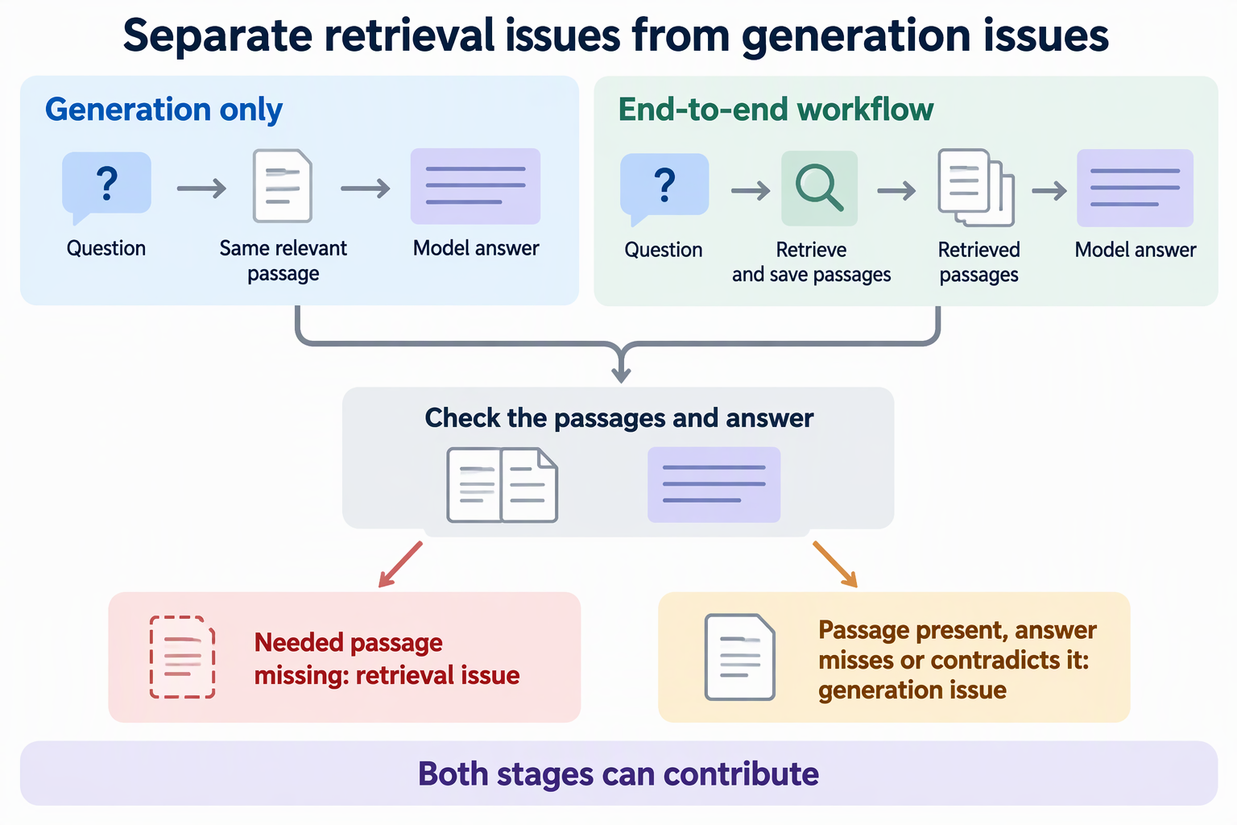
Report end-to-end results and generation-only results as different findings. A model that does well with clean, hand-picked context may still struggle when retrieval sends it noisy or partial passages.
Interpret the Pattern Within the Tested Scope
Describe the observed pattern across each grading dimension without merging them into a single aggregate score or arbitrary pass mark. For example, note if policy comparisons are consistently supported yet frequently omit one required clause. The diagnostic value lies in seeing whether the model errs toward incompleteness or unsupported additions.
Keep conclusions to the scope you tested. A task-defined set supports conclusions limited to the task and inputs tested: these documents, this question mix, this model, this configuration. Name what you left out, such as scanned files, multi-document questions, or a different context length or retrieval setting. If any of those change, test the changed setup again.
Expect the set to change over time. The guide treats evaluation data as something that evolves with the real application. It also notes that high metric scores paired with low user satisfaction suggest the dataset is not representative. If users report problems your test never caught, add those questions and run it again.
FAQs
Can a compact question set give me a statistically precise performance estimate?
Not by itself. A compact set works well for spotting failure patterns, but a precise estimate requires sample size choices based on stated assumptions. In the evaluation guide’s example, sample size depends on confidence and margin-of-error assumptions. For independent binary outcomes, the guide’s normal-approximation example uses an expected 80% rate, 95% confidence, and a margin of 5 percentage points to estimate about 246 samples. Correlated questions drawn from the same documents do not automatically meet that assumption. That figure applies only under those assumptions. It is not a quota.
Can an answer be factually correct but still fail a grounded-answer check?
Yes. If the task requires answers based on your supplied documents, a claim those documents don’t back counts as unsupported, even if it happens to be true in the real world. The model may be drawing on its own training knowledge. Record it as lacking document support, and check its real-world truth as a separate question if that matters.
Should I combine public benchmark results and my document-test results into one score?
No. They cover different tasks, so mixing them produces a number that describes neither one. Report benchmark results as background. Report your document-test findings on their own, along with the documents, questions, and setup they cover.