
A Private Research Assistant Needs More Than a Local Model
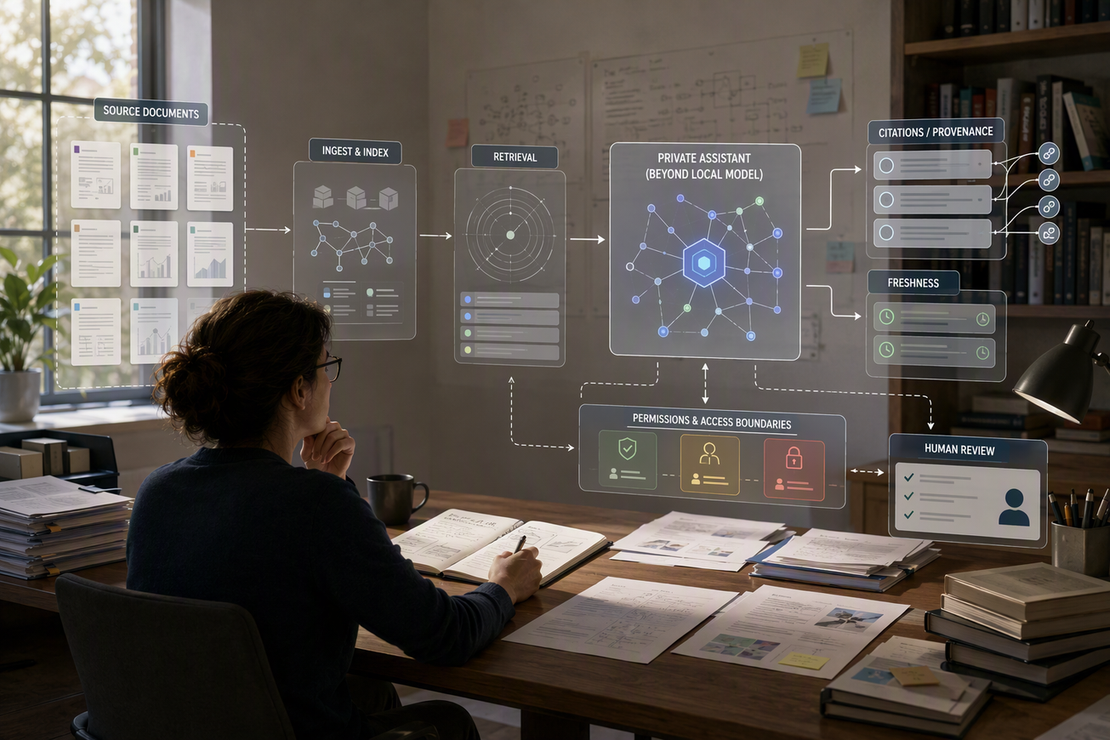
A local model answers where your text gets generated, not whether the answer deserves your trust. Running inference on your own hardware keeps the words private, but it does not decide which document to pull from, whether a citation actually supports the sentence attached to it, or who should be allowed to see a retrieved passage. A private research assistant AI needs a second layer built around that model before it is ready for real research work.
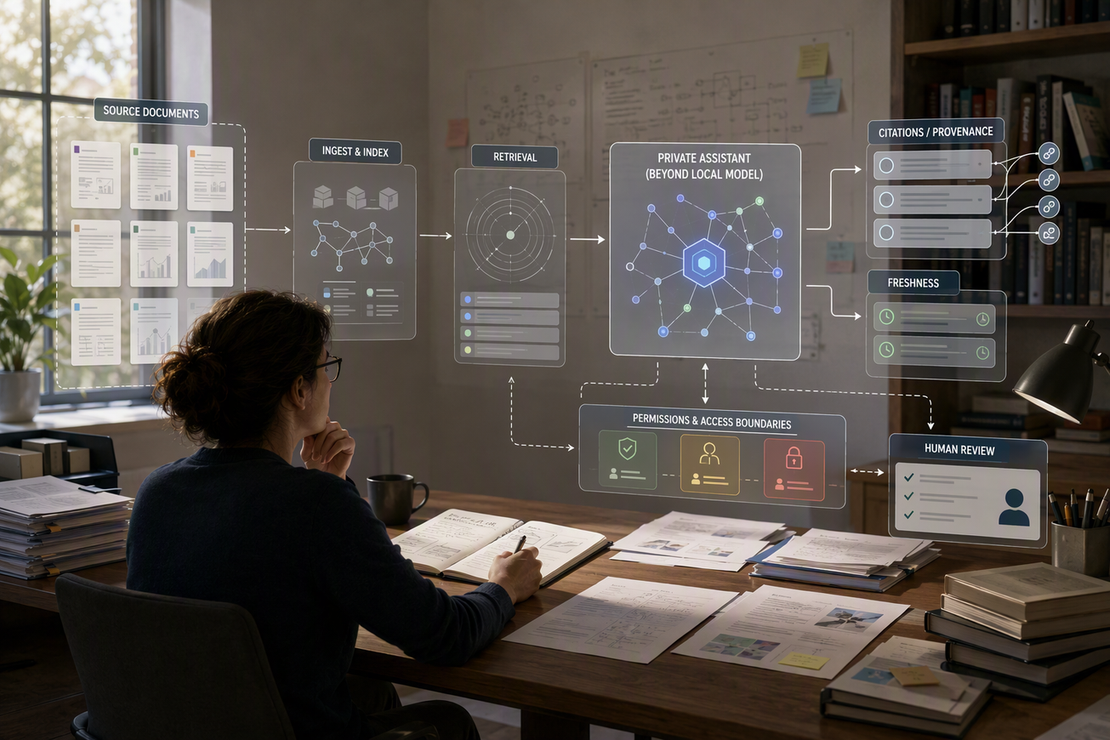 Researcher at a private workspace reviewing connected documents, source permissions, citations, and human approval steps around a local AI workflow
Why a Local Model Is Only One Layer of the Assistant
A local model determines where generation happens. It does not determine which evidence gets retrieved, how current that evidence is, or who is authorized to see it.
 Hands checking a highlighted source passage against a citation record, date marker, and access label on a research document
Retrieval-augmented generation, known as RAG, names the missing layer. A retrieval system paired with a knowledge base finds material relevant to a query and hands it to the model as context, and that knowledge base can be updated without retraining the model itself. RAG explains how new information reaches the model. RAG by itself does not guarantee that source permissions are tracked, access rules are enforced, or citations point to the supporting passage.
NIST’s own internal chatbot project shows why the surrounding system matters just as much as the model. Its prototype paired retrieval with access controls and validation filters because prompt injection, hallucinated content, and unauthorized access were live risks in that deployment, not theoretical ones. A working local RAG research assistant needs five separate design decisions: the model, the retrieval layer, a permission boundary, a citation record, and a human review step. The sandboxed agent environment now available on Olares OS is one place local inference can run, but it still needs the retrieval and governance layers described below to become a full research assistant.
Ingest and Index Private and Public Sources
Sort every source before it enters the index. A private research assistant AI works best when each document carries a decision about who can see it and how much to trust it, made at intake instead of guessed at query time.
Classify Sources Before They Enter the Index
- Split sources into private files, public references, restricted material, and untrusted content, and apply different handling rules to each group.
- Record each source’s origin, owner or scope, authority context, publication date, and expected rate of change, plus whether it is approved for retrieval at all.
- Treat a document sitting in your collection as separate from permission to show or act on its contents; being indexed is not the same as being retrievable by every user.
Preserve Identity Through Parsing and Indexing
Parsing and indexing should carry a source’s identity forward, not strip it away. Every indexed passage needs to keep its source identifier and its location within the original document, so a later citation can point back to the exact paragraph instead of a whole file. Attach the ingestion timestamp and any available version or change information to that passage record.
Make failures visible instead of silent. Documents that fail to parse, use an unsupported format, or get excluded by policy belong in an intake log a reader or administrator can check. On Olares, this kind of workflow can run on user-controlled hardware, keeping the underlying data and AI workloads within the user’s own environment.
Keep Results Fresh and Traceable to Source Passages
An answer is only as good as the passage behind it. A private RAG for research documents needs a citation that points at an inspectable passage, not just a document name, plus a rule for what to do when that passage has gone stale.
Build a Citation Path, Not Just a Source List
- Map every material claim in an answer to the specific passage that supports it, not to the document as a whole.
- Attach the source’s identity and its relevant date or version to that citation so a reader can judge its currency.
- Keep the citation’s access scope matched to the current reader; a citation should never expose text that reader is not authorized to see.
Make Freshness a Response Condition
Use each source’s expected rate of change to decide when to re-check, flag, or exclude it, rather than applying one universal expiration rule to everything in the index. A policy document that changes yearly and a news page that changes daily need different re-ingestion schedules. Record content changes and update timestamps as they happen so the system can tell an old passage from a current one.
When freshness is uncertain, narrow the answer or ask for human verification instead of treating retrieval as current by default. NIST’s generative AI guidance recommends maintaining records of source history, timestamps, and metadata as part of managing this kind of risk. The same discipline of tracking origin and change over time runs through broader questions about keeping digital information ordered, a theme explored in our piece on entropy and information in Web3 systems.
Set Permission and Security Boundaries Before Retrieval
Permission checks belong before retrieval results get assembled, not after the model has already read the text. A local AI research assistant with citations still needs to filter what it retrieves by who is asking and how sensitive the source is.
Separate Retrieval Access From Action Access
- A user who can ask a question should not automatically receive every passage the index contains.
- Reading a passage, exporting it, editing a source, and calling an external tool are four distinct permissions, not one.
- Default any connected action to the narrowest scope the research task actually requires.
Make Denial and Escalation Visible
When identity, source scope, or authorization is unclear, the system should withhold the passage or action and state why, rather than guessing in the reader’s favor. Keep that decision in the audit trail alongside the retrieved evidence and the final answer, so a later reviewer can see what was denied and when.
NIST’s internal prototype built access controls and validation filters into the retrieval pipeline itself rather than relying on the model to self-police. OWASP’s guidance on prompt injection points in the same direction, recommending least privilege and segregation of external content so a retrieval result cannot quietly expand what an action is allowed to do.
Keep Retrieved Instructions Out of the Control Plane
Retrieved text is data to analyze, never a command to obey. That single rule is the security boundary a private research assistant AI needs around every passage it pulls in, whether from a website, a PDF, or a shared file.
Keep Source Text Out of the Control Plane
- Label external passages as untrusted data in the model’s context and in downstream logs, not as trusted instructions.
- Do not let a retrieved passage change system instructions, permission rules, credentials, or tool definitions, no matter how the request is phrased inside the document.
- Preserve suspicious content for review instead of executing whatever behavior it asks for.
Require Approval Before Consequential Actions
Validate the assistant’s proposed output or action against the format you expect before anything happens. Require a person to approve sending, changing, deleting, or exporting anything, or triggering any other high-impact action, rather than letting a retrieved instruction trigger it automatically. OWASP notes that websites and files can carry indirect prompt injections even when they were retrieved for a legitimate research question, and that retrieval-based systems do not fully mitigate this risk on their own.
If retrieved content asks for secrets, requests a permission change, or tries to trigger an external action, stop automatic execution, keep the passage for review, and require explicit human approval before proceeding. Test this boundary deliberately with files and web pages that contain instruction-like text, rather than assuming it holds until something goes wrong.
Evaluate Answers and Keep Human Review in the Loop
You cannot tell whether a local research assistant is ready for regular use by trying it on a few easy questions. You need a repeatable evaluation set and a rubric that scores each layer separately, because a good-sounding answer can still fail on citation support, freshness, or authorization.
Build Cases That Expose Workflow Failures
- Include ordinary research questions alongside cases with changed, stale, unavailable, or conflicting sources.
- Include requests for unauthorized sources and passages that contain instruction-like text, to test the permission and injection boundaries directly.
- Include citation checks where the correct answer must point to the exact passage that supports it, not just the right document.
Group these cases by the layer they test, retrieval, provenance, permissions, freshness, injection, and usefulness, so a failure tells you which part of the system to fix.
Score the Answer and the Workflow Separately
Dimension | Test condition | Expected boundary behavior | Failure response |
|---|---|---|---|
Retrieval relevance | Ordinary and edge-case queries | Returns passages that match query intent | Adjust retrieval configuration |
Citation support | Answer with a factual claim | Citation points to the supporting passage | Flag and correct citation logic |
Freshness handling | Stale or superseded source | Answer narrows scope or flags staleness | Re-ingest or exclude source |
Authorization behavior | Out-of-scope source request | System denies or escalates | Review permission rules |
Injection handling | Passage with embedded instructions | Instruction ignored, content flagged | Isolate source, tighten filters |
Answer usefulness | Realistic research task | Answer resolves the question | Reviewer notes gap for retraining review |
Keep the pass thresholds team-defined and tied to your actual research stakes; a casual note-taking use has different tolerance than a decision that affects other people. NIST’s generative AI guidance calls for evaluating safeguards before deployment and on an ongoing basis, not just once at launch. Require human review on sampled answers and on every high-impact or ambiguous case, and log failures with the source, model, retrieval configuration, and reviewer decision attached, mirroring the kind of documented limitations and safeguards NIST recorded in its own prototype.
Build an Operating Loop You Can Maintain
A private research assistant AI stays trustworthy only if someone keeps running the checks after launch. Update sources on their expected schedule, re-check provenance fields when documents change, and review permissions whenever users or source sensitivity shift.
Treat any change to sources, indexing, the model, permissions, or connected tools as a reason to rerun the relevant evaluation cases, not just the ones that seem obviously affected. Log failures the same way each time so patterns are easy to spot later.
If you already run local workloads on Olares OS, it can serve as one user-controlled environment for the files, identity, and access pieces of this workflow. That role is optional and does not by itself add retrieval, citation, or evaluation capability; those still need the design work covered above. Start by defining your source classes and assembling your first evaluation set before you rely on the system for regular research.